


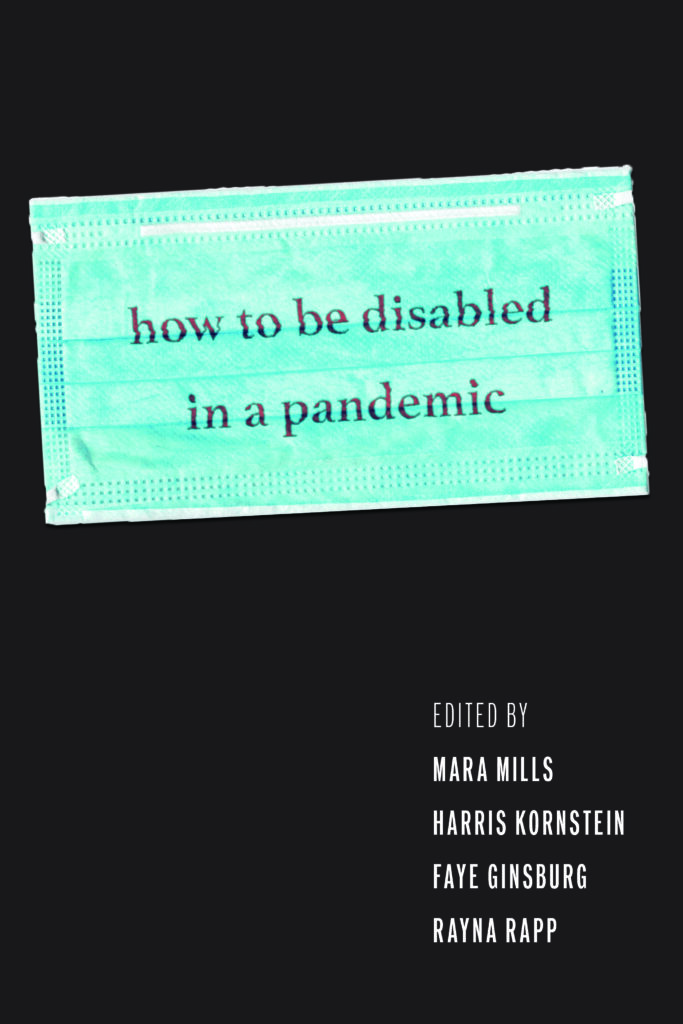
CDS director Mara Mills’ edited book How to be Disabled in a Pandemic (coedited with MCC alum Harris Kornstein and NYU professors Faye Ginsburg and Rayna Rapp), won the 2026 Foundation for the Sociology of Health and Illness Book Prize. A $619,000 NSF grant (PI: Mills) funded the training of doctoral students to research and write chapters for the book. NYU students/alums who participated include: Rachel Kuo (MCC), Harris Kornstein (MCC), Amanda Morris (MCC), Emily Lim Rogers (SCA), Nadia Mbonde (Anthro), Shuting Li (Anthro), Cara Ryan (Anthro), Aiyuba Thomas (Gallatin), and Bojana Coklyat (Gallatin).
The FSHI Book Prize of £1,000 is awarded annually each September to the author(s) or editor(s) of the book making the most significant contribution to medical sociology/sociology of health and illness and having been published over the three years preceding 1st January of the year in which the award is made.
For more, view the full announcement.
More about How to be Disabled in a Pandemic:
The book documents the pivotal experiences of disabled people living in an early epicenter of COVID-19: New York City. Among those hardest hit by the pandemic, disability communities across the five boroughs have been disproportionately impacted by city and national policies, work and housing conditions, stigma, racism, and violence—as much as by the virus itself. Disabled and chronically-ill activists have protested plans for medical rationing and refuted the eugenic logic of mainstream politicians and journalists who “reassure” audiences that only older people and those with disabilities continue to die from COVID-19. At the same time, as exemplified by the viral hashtag #DisabledPeopleToldYou, disability expertise has become widely recognized in practices such as accessible remote work and education, quarantine, and distributed networks of support and mutual aid. This edited volume charts the legacies of this “mass disabling event” for uncertain viral futures, exploring the dialectic between disproportionate risk and the creativity of a disability justice response.
How to Be Disabled in a Pandemic includes contributions by wide-ranging disability scholars, writers, and activists whose research and lived experiences chronicle the pandemic’s impacts in prisons, migrant detention centers, Chinatown senior centers, hospitals in Queens and the Bronx, subways, schools, housing shelters, social media, and other locations of public and private life. By focusing on New York City over the course of three years, the book reveals key themes of the pandemic, including hierarchies of disability “vulnerability,” the deployment of disability as a tool of population management, and innovative crip pandemic cultural production. How to Be Disabled in a Pandemic honors those lost, as well as those who survived, by calling for just policies and caring infrastructures, not only in times of crisis but for the long haul.